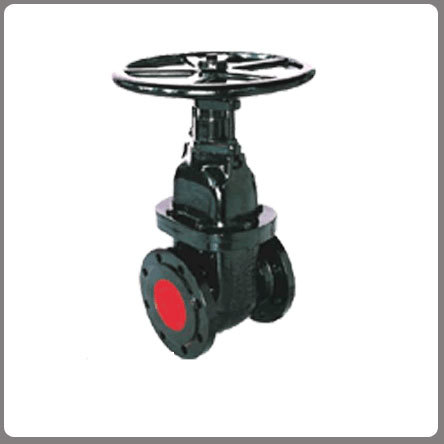
D.I Sluice Valve About
The sole purpose of the D.I sluice valve is to start or stop the flow. It is utilised for slurries and water delivery systems. This product is put in place to shut off the supply and regulate the water flow through a straight pipe.
There is wide spectrum of these valves available with us. These are designed in best manner. We are offering these valves in customized and non customized options to our clients. These sluice valves are flawless in their performance and have robust construction as well. Last but not the least, we are offering these at affordable price.
Specifications: :
- International design
- Guranted Quality
- Standard specification
Technical Specification
| Description | Materials & specification |
| Body | Cast iron to IS:210 Gr. FG 200 |
| Body seat ring | G.M. IS:318. LTB-2 |
| Wedge | Cast iron to IS:210 Gr. FG 200 |
| Wedge seat ring | G.M. IS:318, LTB-2 |
| Wedge nut | G.M.IS:318, LTB-2 |
| Gasket | Rubber/IS: 638 type-B |
| Bonnet/cover | Cast iron to IS:210 Gr. FG 200 |
| Spindle | S.S. IS:6603 12 Cr 13 |
| I" packing | Graphited asbestos rope |
| Gland | Cast iron to IS:210 Gr. FG 200 |
| Hand wheel | Cast iron to IS:210 Gr. FG 200 |
| Bolts & nuts | Carbon steel IS:1363 |
| Thrust plate | Cast iron to IS:210 Gr. FG 200 |
| Cap | Cast iron to IS:210 Gr. FG 200 |
Superior Construction and MaterialsBuilt from ductile iron and enhanced with a fusion-bonded epoxy coating, this sluice valve offers exceptional strength, corrosion resistance, and longevity. Encapsulated rubber ensures a tight seal, while the stainless steel stem provides durability against operational wear.
Wide Range of ApplicationsThis resilient seated sluice valve is ideal for clean and raw water, neutral liquids, sewage systems, fire protection, and municipal water supply networks. Its versatility covers multiple sectors, making it suitable for both industrial and civil use.
Simplified Operation and MaintenanceThe non-rising stem design simplifies installation in confined spaces, and manual operation via handwheel or gearbox ensures user-friendly functionality. Regular maintenance is straightforward, thanks to the bolted bonnet and robust sealing technology.
FAQs of D.I Sluice Valve:
Q: How does the D.I Sluice Valve ensure effective sealing in water and sewage applications?
A: This valve utilizes a resilient seated design, with the disc encapsulated in EPDM/NBR rubber, ensuring leak-tight performance and durability against various water and sewage media.
Q: What is the recommended process for installing the D.I Sluice Valve?
A: The valve should be mounted between flanged pipe connections, ensuring proper alignment. Tighten bolts evenly, and confirm that the fusion bonded epoxy-coated surfaces remain undamaged during installation to preserve corrosion protection.
Q: When should I choose a handwheel versus a manual gearbox operation for this sluice valve?
A: Handwheel operation suits smaller port sizes and low-frequency use, while manual gearbox is ideal for larger valves (above 300mm) or where greater torque and control are required.
Q: Where can this sluice valve be effectively applied?
A: It is suitable for municipal water supply networks, sewage treatment plants, fire protection systems, irrigation channels, and industrial piping setups handling clean or raw water and neutral liquids.
Q: What benefits does the fusion bonded epoxy coating provide?
A: The coating offers superior protection against foreign particles and corrosion, significantly extending the valves service life and maintaining water purity standards.
Q: How do the valves pressure and temperature capabilities support its usage in diverse environments?
A: With a working pressure range from PN 1.0 MPa to PN 1.6 MPa and temperature tolerance from -10C to 80C, the valve reliably functions under a wide variety of conditions encountered in water and sewage systems.
Q: What maintenance steps are recommended for long-term reliable operation?
A: Routine inspections should focus on seal integrity, operation of the handwheel or gearbox, and checking for coating damage. Periodic lubrication of the stem and replacement of seals can enhance performance and longevity.





 Send Inquiry
 Get Latest Price

